An AI Engineer and a Judge on One Stage: What I Took Away from Maiday 2026
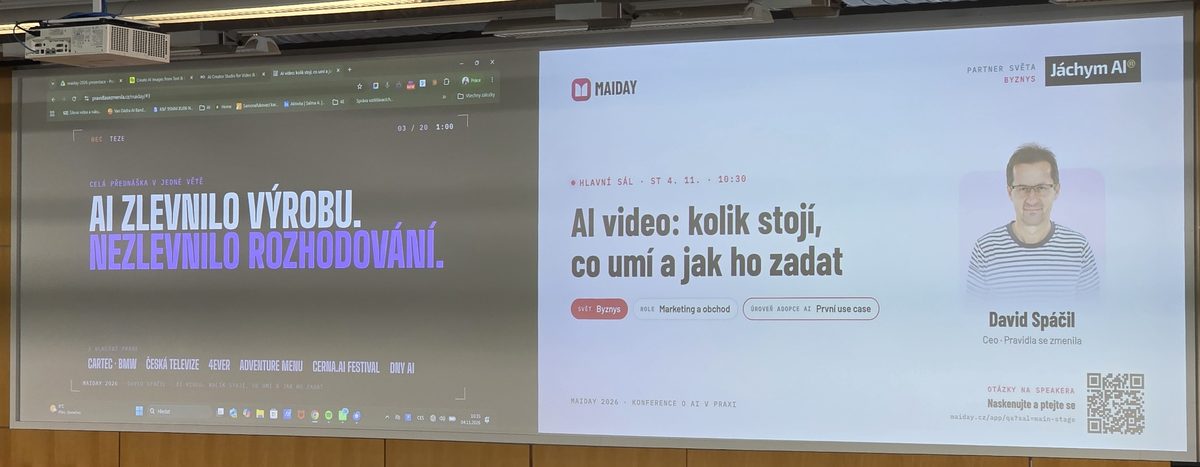
One of David Špáčil's slides read: “AI made production cheaper. It did not make decisions cheaper.” The two talks I took the most from on Wednesday morning at Maiday confirmed that sentence from completely opposite ends. One was given by a man who brings AI into companies. The other by the Vice-President of the High Court in Prague.
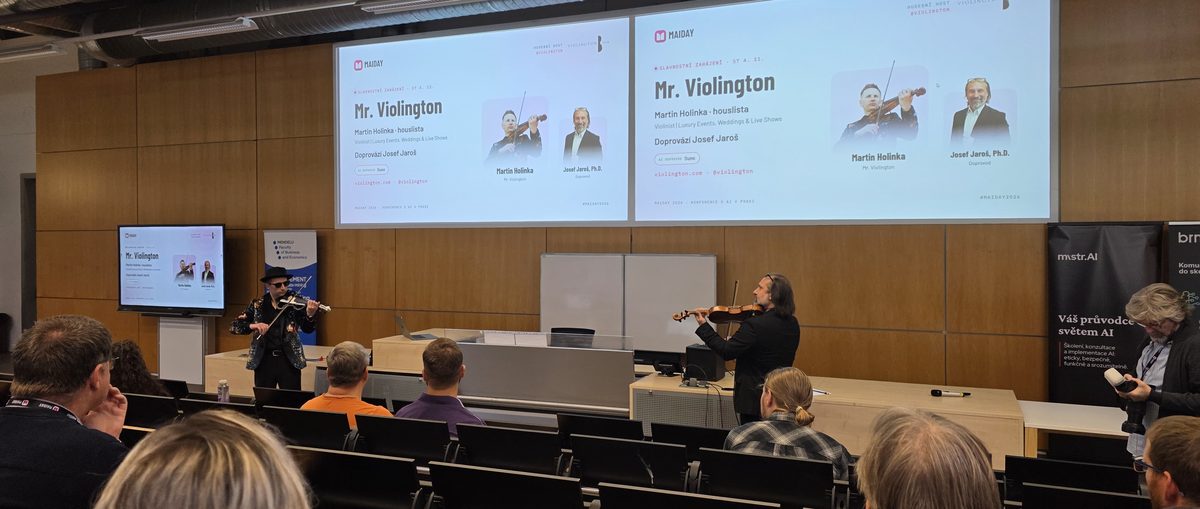
The first edition of the Maiday conference took place on 4 and 5 November at Mendel University in Brno. The programme was split into three areas (business, science and education, public sector), and each talk was labelled with the level of AI adoption it was meant for. It opened with violinist Martin Holinka, aka Mr. Violington, and Josef Jaroš. Their backing track was generated in Suno, but the stage still belonged to two people with violins. A fitting start to a day that kept circling back to one question: where should the human stay?
Why giving Honza a licence is not enough
Václav Adamec of Brno-based Gauss Algorithmic, a company working with AI since 2013, opened with two employees of a manufacturing firm. Petr operates an expensive machining centre, and nobody would dream of letting him near it without training. Honza got an AI licence and the words “figure it out somehow”. So he asks a language model to write programs for a CNC machine. Tolerances there are measured in thousandths of a millimetre, the model has never seen the company's own tool names, and a mistake costs not a backspace but potentially the whole machine.
Adamec has a well-known slogan rewritten on his mug. Instead of “another meeting that could have been an e-mail”, it says “another agent that could have been just a script”. He added a story from a large telecom company: a colleague proudly presented a multi-agent platform with eight agents, and it turned out that seven of them could have been ordinary scripts.
What to ask before you roll out AI
He called four questions the most important slide of his talk. The first is whether I really understand the process. Adamec recommends sitting next to a colleague for a day and watching what they actually do. In one company system, step seven is an automatic translation that is useless, so Pepa quietly redoes it in DeepL. Nobody outside knows. Once the process is automated according to the paperwork, customer complaints start coming in.
The second question is whether we have the data. In manufacturing companies, production itself tends to be spotless, while quotes, sales and engineering are, in Adamec's words, a “stone age” of spreadsheets and paper. The third is whether we know what it will save. The metric does not have to be money. It can be an overloaded process engineer who gets rid of an hour of hated work a day and therefore does not quit two months later. The fourth is whether we have the capacity: a project needs an owner, not just an enthusiastic IT person, and a CEO who uses AI himself. And finally the most uncomfortable one: does it have to be AI at all?
For projects that pass through this sieve, Adamec recommends an impact × effort matrix. Start with quick wins, not strategic projects. As he put it: “Eat the elephant starting from the tail.”
This is where I step in as a lawyer. Pepa's DeepL is a textbook case of shadow AI: company and client texts flow into a tool whose terms the company knows nothing about. And “does it have to be AI?” has a regulatory side too. Under the AI Act, a system that merely executes rules written by humans is generally not an AI system at all (recital 12). A script is therefore not only cheaper but also legally simpler.
Why you want to crash early
The second half of the talk was about “crash cheap and fast”. The Gauss Algorithmic team built a voicebot for the drive-through kiosks of Burger King in France. The first version was ready quickly and worked brilliantly at the client's office. In real operation it soon crashed. A car with a family pulls up, dad orders a menu, the daughter in the back seat wants different fries than her sister, wind is blowing and cars are honking. And people who realise they are talking to an AI start testing it with nonsense. It was not the model that failed but the input: a single microphone picking up sound from everywhere. Getting the project to where the client wanted it took a long time after that. According to Adamec, it still paid off that the crash came early and cheaply.
And what does the judiciary say?
Right after him came JUDr. Roman Horáček, Ph.D., MBA, Vice-President of the High Court in Prague and founder of the Centre for Digitalisation and Artificial Intelligence in the Judiciary (CendAI). He started soberly. Until recently, the judiciary was still working on having a functioning filing system at all, and court outputs are still mostly on paper. As a lawyer, I smiled at the CD-ROM with a case file that I no longer have anything to play on in my office.
The most common prompt in the chatbot available on the judicial network was reportedly “write me a judgment”. That is exactly what the team is trying to prevent. Horáček presented iSoud, a system that first pseudonymises the case file locally, then summarises it, finds relevant case law and prepares materials for the decision. The most interesting part was the story of the first version. It drafted the entire decision, and according to Horáček the test judges “simply adopted it”. It looked good, was well written and full of case law. So the team reversed the logic. After the summary, the judge now has to decide himself whether to grant or dismiss the claim. The output is deliberately in bullet points so it cannot simply be copied. And for the chosen option, the system adds counter-arguments on its own, i.e. what might not survive an appeal. According to Horáček, the system could free up roughly the capacity of one district court and go live within months.
Uncomfortable topics came up too. According to Horáček, the general public often prefers a machine to a judge because they believe a machine is transparent and predictable. “That is precisely not true,” he replied. He went on to talk about deepfake evidence, where according to forensic experts we can currently detect manipulation only to a limited extent, and about companies offering personality profiling of judges. In France, he said, this is a criminal offence. CendAI also runs a public overview of AI hallucinations in court proceedings. I covered the wider context in my article AI in Court.
Where did the two talks meet?
Honza at the manufacturing firm and the test judges did exactly the same thing: they adopted the AI output because it looked good. The AI Act has a term for this, automation bias. For high-risk systems, human oversight must be designed so that people remain aware of this tendency (Article 14(4)(b)). A system that assists judges in researching and interpreting facts and the law is classified as high-risk (Annex III, point 8). Following the Digital Omnibus regulation, these obligations now apply from December 2027. Horáček's team is therefore building human oversight into the system before it becomes mandatory, and not into a policy document but into the design of the application itself.
Which brings me to the third slide I photographed that day. In her talk “Do you really have AI under control?”, Alžběta Solarczyk Krausová showed: “A PDF called ‘AI Policy’ is not effective AI governance. AI policies describe behaviour. Systems change it.” iSoud is exactly that case. Nobody has to lecture the judge not to copy the output, because the application does not let him.
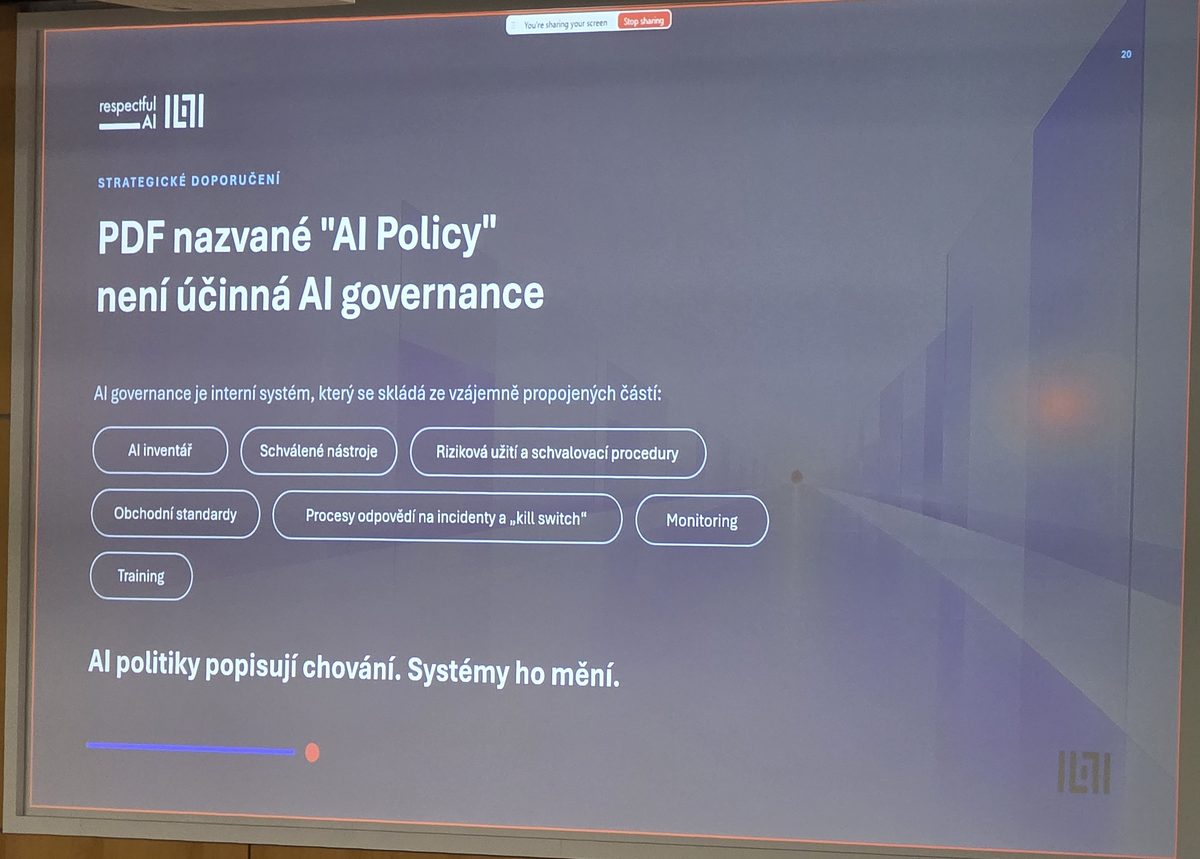
AI policies describe behaviour. Systems change it.
One legal side note. iSoud sends the pseudonymised text via API to the Claude model, i.e. to the US. Pseudonymisation is a good step, but for whoever holds the key, the data remain personal data. Whether they are personal data for the model provider as well depends, according to the Court of Justice of the EU (C-413/23 P), on whether the provider can realistically link them to specific people. Horáček himself admitted that pseudonymisation is not one hundred per cent reliable. That is another reason why I think it is right that the system asks the judge to check uncertain cases before sending the text on.
What should companies take from this?
I am taking home two simple questions. How many AI outputs in your company just get copied along because they look good? And how many of your “agents” could have been an ordinary script?

Planning to roll out AI in your company and want clarity on contracts, data and liability? The first 30 minutes of consultation are free and in plain language.
Book a consultationSources and further reading:
- Lupa.cz: A new AI system for judges could start operating in Czechia within months (12 Oct 2026, in Czech)
- Lupa.cz: Roman Horáček (High Court): AI threatens trust in the judiciary (29 May 2026, in Czech)
- CendAI: overview of AI hallucinations in court proceedings (in Czech)
- Regulation (EU) 2024/1689 on artificial intelligence (AI Act), Article 14 and Annex III (EUR-Lex)
- Regulation (EU) 2026/1744 (Digital Omnibus on AI) (EUR-Lex)
- CJEU judgment of 4 September 2025, EDPS v SRB, C-413/23 P (Curia)