When AI Makes a Mistake, the Bill Goes to You
Imagine that your development company uses GitHub Copilot to write code for a client. Everything runs smoothly until a hidden bug appears after deploying to production. The client's e-shop crashes, and the damage goes into the millions.
Or another scenario. A tax advisor lets ChatGPT calculate taxes, a decimal point shifts in the model, and the client sends a nonsense to the tax authority based on that in June.
Who pays the damages in such situations? Can you blame the technology, or transfer the liability to OpenAI or Microsoft?
In Czech law, the situation is relatively straightforward. Liability for damage caused by artificial intelligence is not yet regulated by any special law. Disputes will therefore be resolved according to the general rules of the Civil Code and the content of specific contractual relationships.
Why you can't put software code on trial
The first step to understanding the problem is to realize that from a legal perspective, artificial intelligence does not have a legal personality. It is not a subject, but a tool – just like a calculator, Excel, or a backhoe.
When a backhoe driver cuts a gas pipeline during work, no one sues the backhoe. The liability is borne by the construction company that used it. The exact same logic applies to artificial intelligence. The injured client will always seek damages from you, not from the software.
How the client contract looks at errors
When you deliver broken code or a faulty spreadsheet, the relationship with the client is governed by the contract and the Civil Code.
Contractual liability for results
Czech law stands on the principle of strict (objective) liability in contractual relationships (§ 2913 of the Civil Code). If you undertake to deliver a functional work and deliver it with a bug, you are liable for damages regardless of whether you caused the error. You can only discharge liability by referring to force majeure – i.e., an extraordinary, unpredictable, and insurmountable obstacle. The fact that the ChatGPT or Claude model happened to hallucinate is by definition not force majeure. It is an internal technological risk that you bear as a supplier.
When an algorithm works for you
For a better idea of how liability works, a loose analogy to the helper provision (§ 1935 of the Civil Code) serves well. This provision states that anyone who performs through another person is liable as if they performed themselves. Because AI is not a person but only a tool, this rule cannot be applied literally. The practical impact, however, is identical: if you use AI for your work, you warrant the result in the same way as if you assigned the task to a junior employee or an external subcontractor. The client does not care about the internal process of creation; they care about a flawless result.
Risks of professional advice for reward
If you act as professionals – for example, as tax advisors, analysts, developers, or designers – and provide advice or information for a reward, you are liable for its correctness (§ 2950 of the Civil Code). The law requires a professional standard or professional care from you. Blindly copying output from artificial intelligence without any human review is a clear breach of this care. If the output is not verified and causes damage, your liability is almost undeniable.
The Air Canada Case: Chatbot as the Company's Legal Representative
That these are not merely theoretical academic debates was demonstrated in February 2024 by the Canadian dispute Moffatt v. Air Canada. The airline's chatbot provided a passenger with incorrect information on how to retroactively apply for a bereavement discount on a ticket. When the client claimed the discount, the airline refused to pay it, stating that the chatbot had the wrong information and acted in violation of the official conditions of carriage. Air Canada attempted a bold defense in court: it claimed that the chatbot was a "separate legal entity responsible for its own actions" and that the airline was not liable for its errors.
The tribunal (British Columbia Civil Resolution Tribunal) flatly rejected this defense. It ruled that the company is fully responsible for all information on its website, whether it comes from static text or a chatbot. From the perspective of Czech law, the situation is analogous – the chatbot plays the role of a helper in fulfilling contractual obligations or pre-contractual negotiations, and thus you are acting directly through it.
Transferring damages to tech giants is an illusion
Now it might occur to you to transfer the liability to the creator of the AI system itself, i.e., to OpenAI, Microsoft, or Google. In the B2B sector, however, this is practically impossible.
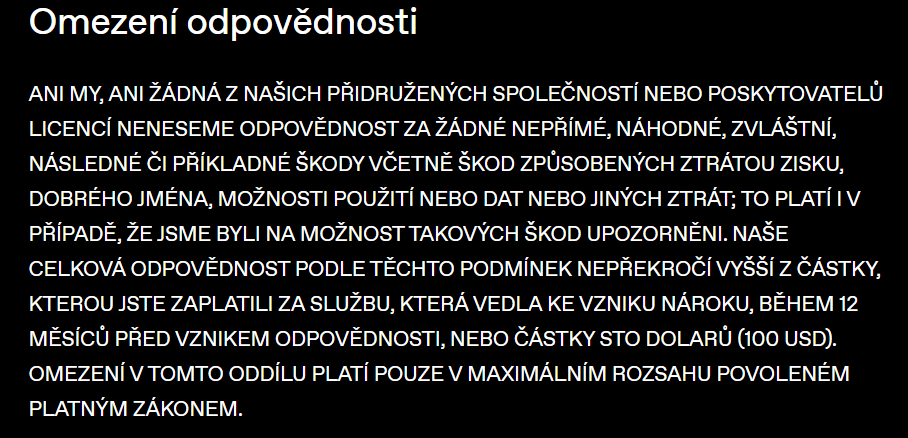
All commercial licenses for large language models contain very strict limitation of liability clauses. Providers explicitly state that the tools are provided "as is" and do not warrant their correctness or accuracy. Any financial limits for potential compensation are also contractually capped at symbolic amounts – most often the amount of subscription fees paid for the last 12 months, or a fixed amount like $100. In business relations, these limitations are legal and fully respected by courts.
A nightmare called "shadow AI" in the workplace
A complicated situation arises if an employee uses AI to perform work tasks secretly or without the management's knowledge.
Towards the client, your company as the employer still bears full liability for damages. However, the Labor Code protects the employee. If they caused the damage through negligence, their liability to you is limited to 4.5 times their average monthly salary. If the damage reaches millions, the vast majority of the costs will have to be covered by the company from its own budget.
How to protect your company and set rules
To avoid unpleasant legal disputes and financial losses, it is necessary to set clear internal processes. In the Czech legal and business environment, it is customary to structure these measures as follows.
The first step is to introduce a clear internal policy (AI Policy). This should define exactly which tools your people can use, what data they can input (with an emphasis on banning the upload of client code and sensitive data), and which specific outputs are subject to an approval process.
The second pillar is the principle of human oversight (Human-in-the-Loop). No code, calculation, or text generated by AI must leave for the client or go into production without review and approval by a qualified employee, who takes personal responsibility for the result.
The third step is to adjust contractual arrangements with clients. In contracts, it is desirable to limit your total liability for damages (for example, to the price of the contract) and, if appropriate, openly define the rules for involving AI tools in development or analysis.
The fourth measure is to check your professional liability insurance. Consult with your insurance company to see if your current professional liability policy covers damages caused by errors in software tools, and under what specific conditions of human oversight the insurer will pay out.
The fifth step (if you deploy public AI chatbots for customer contact) is to set hard technical limits. Do not rely on simply “instructing” the chatbot in a system prompt not to give discounts or alter business terms. After all, it can sometimes be sweet-talked. The chatbot must not have the programmatic capability to generate discount codes or alter prices without human approval.
What the new European rules will bring
Liability for damage caused by AI will in the near future be governed by the revised Product Liability Directive (EU) 2024/2853. It newly defines software and artificial intelligence systems as a "product". Manufacturers, including software developers and AI providers, will bear strict liability for damages. The originally planned separate proposal for a specific AI Liability Directive was officially withdrawn by the European Commission in February 2025 as redundant, and the issue was fully integrated into this general directive and the AI Act regulation.
However, since it is a directive, its transposition into the legal order of the Czech Republic is necessary. Member states have until December 9, 2026, to implement it, with the Czech Republic preparing transposition in the form of an amendment to the Civil Code under the direction of the Ministry of Industry and Trade.
The new rules bring several revolutionary changes. Software (including AI) will start to be classified as a "product", making it easier to enforce liability against its creators or those who perform a substantial modification on the product. The definition of recognized damage is significantly expanded – it now also includes the loss or irreversible damage of data and medically recognized psychological harm. Furthermore, for injured consumers, courts will be able to ease the burden of proof by ordering the mandatory disclosure of source codes or technical documentation, and by applying a rebuttable presumption of defectiveness and causal link in technologically complex "black-box" systems.
Conclusion
Artificial intelligence is an excellent helper but a risky master. Legal liability for its outputs lies fully on the shoulders of those who use it for their business. If you want to prevent paying for algorithm errors, do not underestimate the setup of internal processes and the revision of client contracts.
Sources and recommended reading:
- Act No. 89/2012 Coll., Civil Code (§ 1935, § 2913, § 2950)
- Act No. 262/2006 Coll., Labor Code (§ 250 et seq.)
- Product Liability Directive (EU) 2024/2853
- Artificial Intelligence Act (AI Act) – Regulation (EU) 2024/1689
- Civil decision in Moffatt v. Air Canada